Disclosure: This article may contain affiliate links. As an Amazon Associate I earn from qualifying purchases.
If you’re asking are inkless printers worth it, the best way to decide isn’t by looking at the printer alone. You need to think about what you print, how often you print and how long you need those documents to last.
For the right person, a portable inkless printer can be extremely convenient. There are no cartridges to replace, many models run from rechargeable batteries, and some are small enough to carry with a laptop.
For someone else, the same printer could be frustrating because it requires thermal paper, usually prints only in black and white and isn’t ideal for permanent paperwork.
This guide focuses on one question: does an inkless printer actually make sense for the way you print?
Are Inkless Printers Worth It? The Short Answer
Yes, if you mainly need occasional black-and-white printing and value portability.
We would seriously consider an inkless printer for:
- study notes and worksheets
- temporary forms and documents
- travel
- mobile work
- caravan or campervan use
- small apartments or limited desk space
- people who only print occasionally
We would probably choose something else for:
- colour school projects
- photographs
- permanent records
- large office workloads
- frequent printing where ordinary A4 paper is cheaper
The biggest mistake would be buying one because “no ink” sounds automatically cheaper. It can be cheaper and more convenient, but only in the right situation.
Ask Yourself These 5 Questions Before Buying
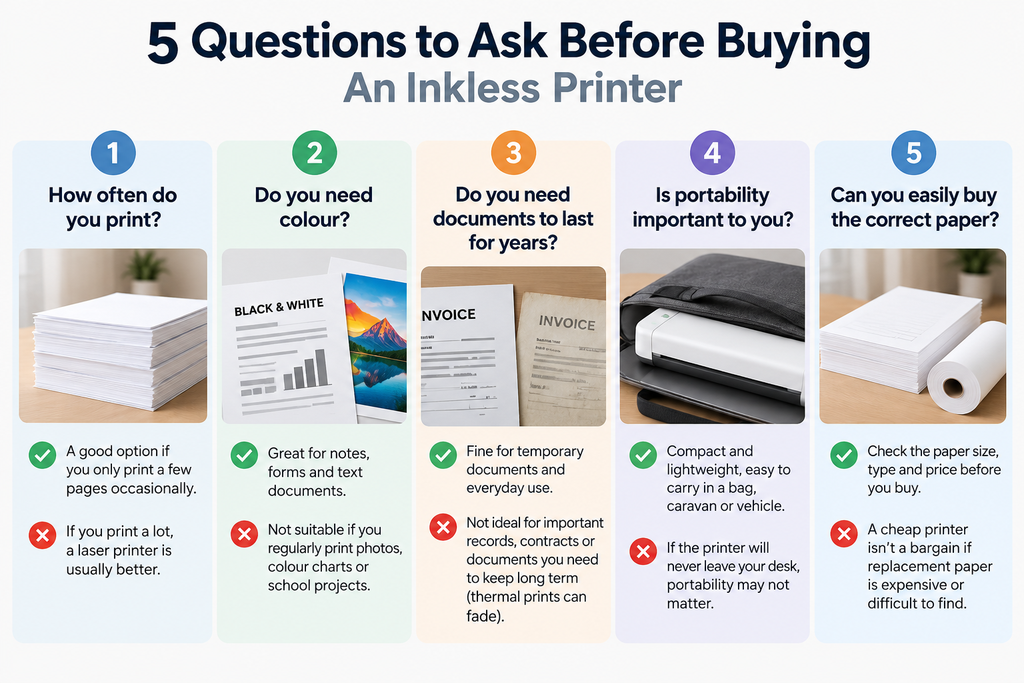
1. How often do you actually print?
This is probably the most important question.
If you only print a few pages every couple of weeks, a portable thermal printer can make a lot of sense. You don’t have ink cartridges sitting unused and potentially drying out between jobs.
If you’re printing dozens or hundreds of pages every day, the advantages become less convincing. A laser printer will normally handle high-volume printing more efficiently.
Occasional printer: inkless can be a good fit.
Heavy printer: look at laser instead.
If you’re deciding between the two technologies, see our thermal printer vs laser printer comparison for a closer look at running costs, paper, speed, portability and document lifespan.
2. Do you need colour?
Most portable A4 inkless printers are designed for black-and-white documents.
That’s perfectly fine for:
- notes
- forms
- checklists
- text documents
- worksheets
- basic diagrams
It becomes a problem when you need:
- photos
- colour charts
- school projects
- marketing material
- colour presentations
If colour is important even occasionally, think carefully before replacing your normal printer completely.
Artists and photographers who need higher-quality color output can see our guide to the best printer for art prints for photo-oriented and professional fine-art printers.
If your main goal is colourful labels, decals or craft projects, see our guide to the best printer for sticker making for more suitable color inkjet options.
3. Do you need documents to last for years?
Direct thermal printing uses heat-sensitive paper.
That is convenient because no ink is required, but it also means the printed image can be affected by heat, prolonged light exposure, friction and certain chemicals.
The National Archives of Australia notes that thermal paper is less stable than conventional permanent paper.
For something you’ll use briefly and then discard, that isn’t much of a problem.
For certificates, legal paperwork, contracts or records you want to keep for many years, we wouldn’t rely on thermal printing as the only copy.
4. Is portability actually important to you?
This is where inkless printers have a genuine advantage.
A normal inkjet printer usually stays on a desk.
A portable thermal printer can often fit into:
- a laptop bag
- a backpack
- a drawer
- a caravan cupboard
- a vehicle storage compartment
If you work from different locations, travel regularly or simply don’t want a large printer taking up space at home, that portability can be worth more than the cost saving.
If the printer will never leave your desk, portability matters much less.
5. Can you easily buy the correct paper?
This is something buyers sometimes overlook.
Direct thermal printers need compatible thermal paper. Ordinary A4 copy paper generally won’t work.
Before buying a printer, check:
- the paper size it requires
- whether it needs individual sheets or rolls
- where you can buy replacement paper
- how much the paper costs
- whether multiple brands of compatible paper are available
A cheap printer isn’t much of a bargain if you later discover its consumables are expensive or difficult to find.
For compatible options and buying advice, see our guide to the best A4 thermal printer paper in Australia, including sheets versus rolls, printer compatibility and what to check before ordering.
The Real Cost: Inkless Printer vs Normal Printer
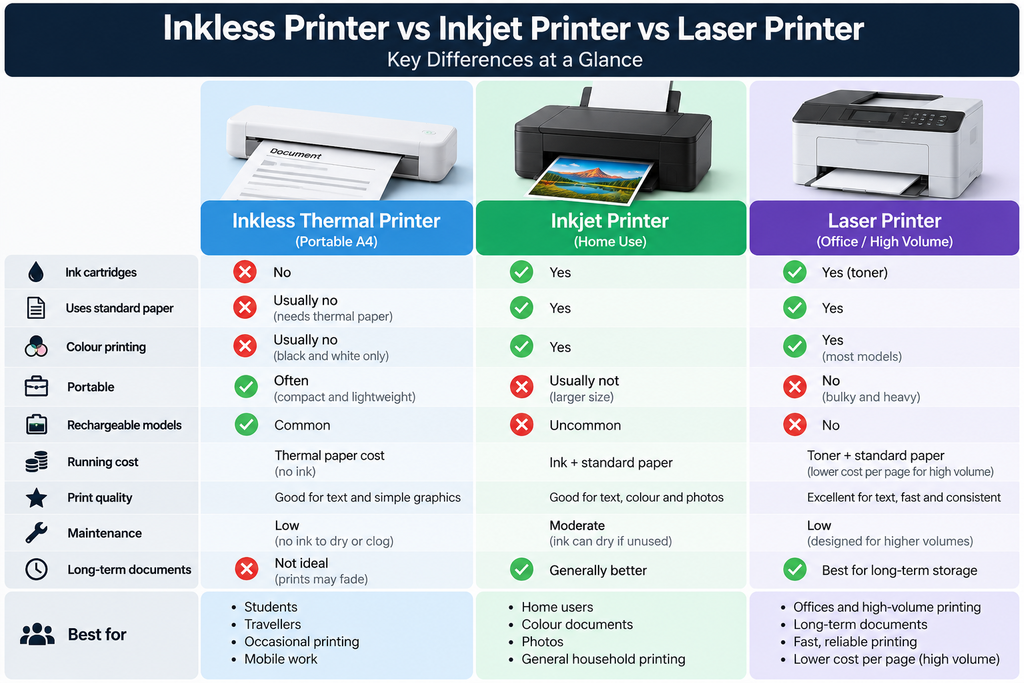
The running-cost comparison isn’t simply “ink versus no ink”.
A normal inkjet uses inexpensive plain paper but requires ink cartridges.
An inkless thermal printer eliminates the cartridge cost, but the paper itself is more specialised.
Think of it like this:
| Cost | Inkless Thermal | Inkjet |
| Printer | Usually affordable | Usually affordable |
| Ink/Toner | None | Required |
| Paper | Special thermal paper | Standard copy paper |
| Maintenance after long periods unused | Generally low | Ink can dry or clog |
For someone who prints infrequently, avoiding cartridges may be the bigger saving.
For someone printing large quantities, cheap ordinary paper and a suitable laser printer may work out better.
When an Inkless Printer Makes a Lot of Sense
Students
A student who mainly needs lecture notes, worksheets, study material and draft documents could benefit from a small portable printer.
It can also be easier to store in a bedroom or small study area than a traditional printer.
Travellers
If you travel and occasionally need a physical copy of a booking, form, itinerary or document, carrying a compact printer can be convenient.
We’d still keep digital copies of anything important.
Caravan and campervan users
This is one of the use cases where the portability really makes sense in Australia.
Space is limited, so a rechargeable printer that doesn’t need ink cartridges can be easier to store than a full-size inkjet.
Mobile workers
People who work from client sites, vehicles, temporary offices or different locations may find it useful to have a printer that doesn’t need to stay plugged into a desk setup.
Mobile workers who need to digitize paperwork as well as print it may prefer a portable printer and scanner setup instead of a print-only thermal model.
For people who need to print invoices, quotes, work orders or other business documents while travelling between jobs, see our guide to the best portable invoice printer in Australia.
For workers who spend most of the day on the road, see our guide to the best portable printer for car use to compare compact battery-powered printers for mobile work.
People who rarely print
If you’ve ever bought an inkjet printer, left it unused for months and then discovered the cartridges no longer work properly, you’ll understand the appeal.
Thermal printing removes that particular problem entirely.
If you already use an inkjet, our guide on how often you should use an inkjet printer explains a simple routine to reduce the risk of dried ink and clogged nozzles.
If you rarely print and want to compare all three technologies, see our guide to the best printer for occasional use in Australia, including laser, inkjet and thermal options.
When We Wouldn’t Buy One
You need one printer for everything
An inkless printer is quite specialised.
If your household prints school projects, family photos, colour documents and permanent paperwork, we’d rather have a conventional colour printer.
For families printing worksheets, colour learning material and other schoolwork at home, see our guide to the best printer for homeschooling in Australia to compare practical ink tank and laser options.
You print a lot
For high-volume document printing, a laser printer is generally more practical.
You get larger paper trays, faster printing and better suitability for long-term documents.
Teachers who regularly print worksheets, lesson plans and classroom material can see our guide to the best printer for teachers for higher-capacity ink-tank and laser options.
You need archival documents
For important paperwork that must remain readable for many years, thermal printing would not be our first choice.
You want cheap ordinary paper
If you already buy inexpensive boxes of standard A4 paper, switching to specialised thermal paper may feel restrictive.
How Long Will Thermal Printing Last?
There isn’t a single answer because the lifespan depends heavily on the paper and storage conditions.
Thermal images can deteriorate faster when exposed to:
- high temperatures
- direct sunlight
- friction
- certain plastics
- oils and chemicals
A document kept somewhere cool and dark may last considerably longer than one left in a hot vehicle or in direct sunlight.
For temporary paperwork, this may never become an issue.
For important records, we’d keep a digital copy and use a conventional printing method where permanence matters.
What Should You Look for When Buying an Inkless Printer?
If you’ve decided the technology suits you, don’t simply buy the cheapest model.
Check these things first:
Paper compatibility
Make sure compatible A4 thermal paper is easy to buy.
Bluetooth support
If you plan to print from your phone, check the supported app and read current user feedback about it.
Computer support
Some printers support Windows and macOS through USB, while others are primarily designed around mobile apps.
Battery
Look at charging time, battery capacity and whether the printer can be used while charging.
Printer size
Not all “portable” printers are equally small. Check the actual dimensions rather than relying on product photos.
Warranty
A local Australian warranty can be valuable, particularly with cheaper electronics.
Replacement paper cost
Look beyond the initial printer price and work out what ongoing supplies will cost.
Should You Buy the Cheapest Inkless Printer?
Not necessarily.
There are many similar-looking portable thermal printers sold online, often at very different prices.
The cheapest model may be perfectly adequate, but we’d compare:
- customer reviews
- app quality
- driver support
- warranty
- paper compatibility
- battery specifications
- Australian retailer support
Paying slightly more can be worthwhile if it means easier paper availability, better software or a more useful warranty.
What About the Kmart Anko Inkless Printer?
If you’re in Australia, one of the more affordable options is Kmart’s Anko Inkless A4 Printer.
Rather than repeating its specifications here, we’ve covered that specific model separately in our Anko Inkless A4 Printer review.
That article looks specifically at the Kmart model, while this guide is intended to help you decide whether inkless printing as a technology suits you in the first place.
Portable Inkless Printers to Compare
If you’ve decided that thermal printing suits your needs, here are three portable A4 models you may want to compare.
- Phomemo M834: A popular portable A4 thermal printer with Bluetooth connectivity for mobile printing. Check the Phomemo M834 on Amazon Australia.
- iDPRT Portable A4 Thermal Printer: A compact portable option designed for wireless document printing and travel use. Check the iDPRT printer on Amazon Australia.
- Rongta Portable Thermal Printer: Another portable thermal printer worth comparing for occasional mobile document printing. Check the Rongta printer on Amazon Australia.
As an Amazon Associate I earn from qualifying purchases.
Our Verdict: Are Inkless Printers Worth It?
They can be — but they’re not for everyone.
We think inkless printers are most convincing as portable or occasional-use printers.
If you mainly print black-and-white documents, don’t want to maintain cartridges and like the idea of carrying the printer with you, the technology makes a lot of sense.
If you need colour, cheap standard paper, permanent documents or high-volume printing, we’d choose a conventional inkjet or laser printer instead.
The important thing is not to treat an inkless printer as automatically better because it doesn’t use ink.
Think about how you actually print. If its strengths match your needs, it can be a very practical little device.
Frequently Asked Questions
Are inkless printers actually worth buying?
Yes, particularly for occasional black-and-white printing where portability and low maintenance are important. They are less suitable for colour, permanent records and high-volume printing.
Do inkless printers save money?
They eliminate ink-cartridge costs, but you still need specialised thermal paper. Whether you save money depends on how frequently you print and the price of compatible paper.
Do inkless printers use normal paper?
Most portable direct thermal models require compatible thermal paper. Standard A4 copy paper generally won’t work.
Can inkless printers print colour?
Most portable A4 thermal printers print only in black and white.
Are inkless printers good for travel?
They can be. Their compact size, rechargeable batteries and mobile printing support make them particularly suitable for people who need occasional documents while away from home.
Are inkless printers good for permanent documents?
We wouldn’t choose them for important records that need to remain readable for many years because thermal paper can fade or react to environmental conditions.
Are inkless printers good for students?
They can be useful for students who mostly print worksheets, study notes and temporary documents and want something compact.
Sources and Further Reading
- National Archives of Australia – Managing Records on Thermal Papers
- WorkTechScout – Anko Inkless A4 Printer Review
Printer features and paper compatibility vary between models. Always check the manufacturer’s current specifications before purchasing.