Disclosure: This article may contain affiliate links. As an Amazon Associate I earn from qualifying purchases.
Editorial note: Printer specifications, consumable prices and availability can change. This comparison focuses mainly on direct thermal portable printers used for A4 documents versus conventional laser printers.
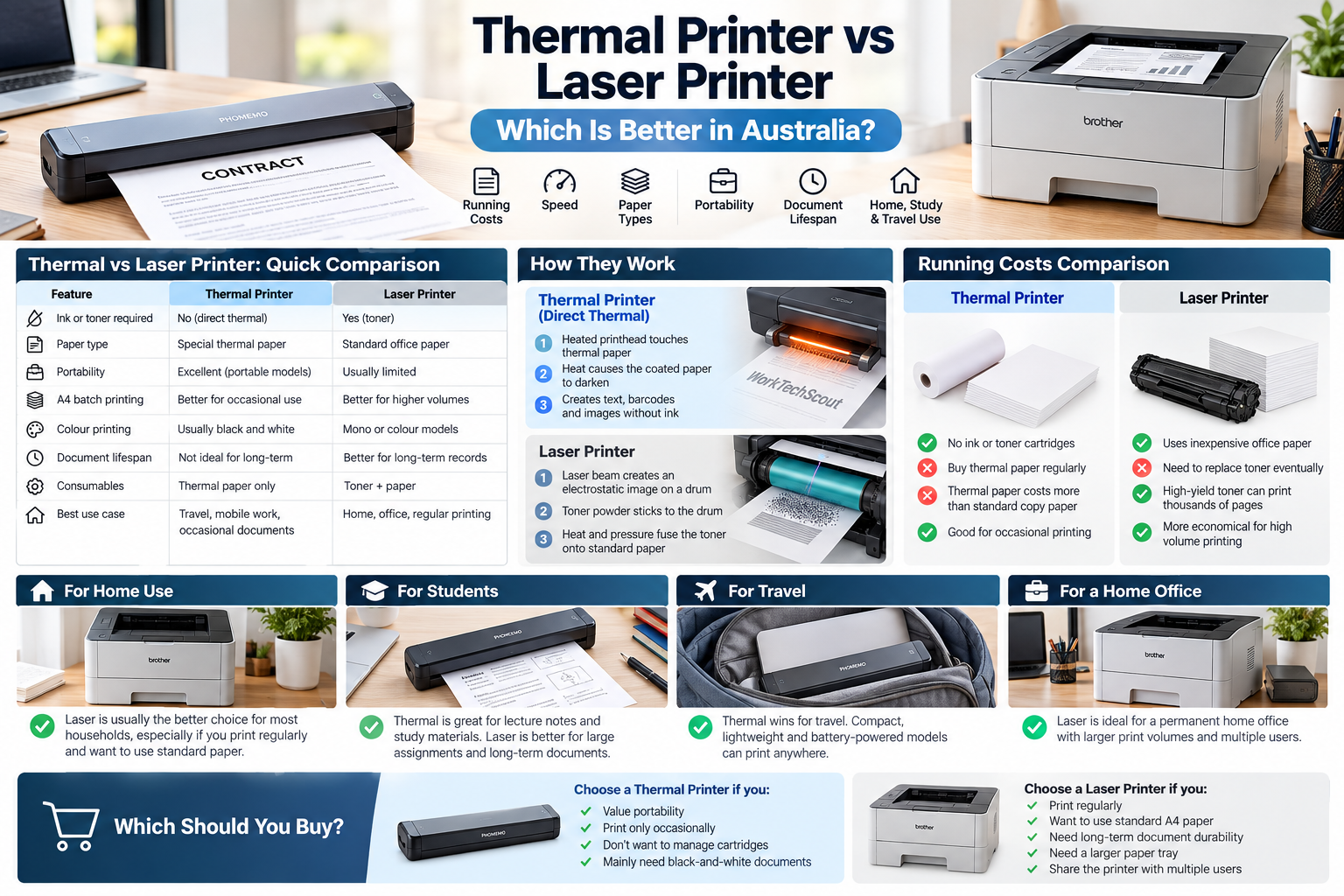
If you’re comparing a thermal printer vs laser printer, the biggest difference isn’t simply whether one uses ink.
The two technologies are designed around very different priorities.
A direct thermal printer creates an image by heating specially coated thermal paper. It doesn’t need ink or toner, and portable models can be small enough to carry with a laptop.
A laser printer uses toner and a more complex printing system but can print quickly on ordinary office paper, handle larger workloads and produce documents that are generally better suited to long-term use.
So which is better?
For mobile and occasional black-and-white printing, thermal can make a lot of sense. For regular home or office printing, particularly when you need ordinary paper and larger print volumes, laser will usually be the more practical choice.
Here’s how the two compare for Australian buyers.
Thermal Printer vs Laser Printer: Quick Verdict
| Category | Thermal printer | Laser printer |
| Ink or toner required | No for direct thermal | Yes – toner |
| Paper | Special thermal paper | Standard office paper |
| Portability | Excellent on portable models | Usually limited |
| A4 batch printing | Better for occasional use | Better for higher volumes |
| Colour | Usually black and white for portable direct thermal models | Mono or colour models available |
| Document longevity | Not ideal for long-term records | Better suited to normal long-term documents |
| Cartridge maintenance | None | Toner eventually needs replacing |
| Typical best use | Travel, mobile work and occasional documents | Home, office and regular document printing |
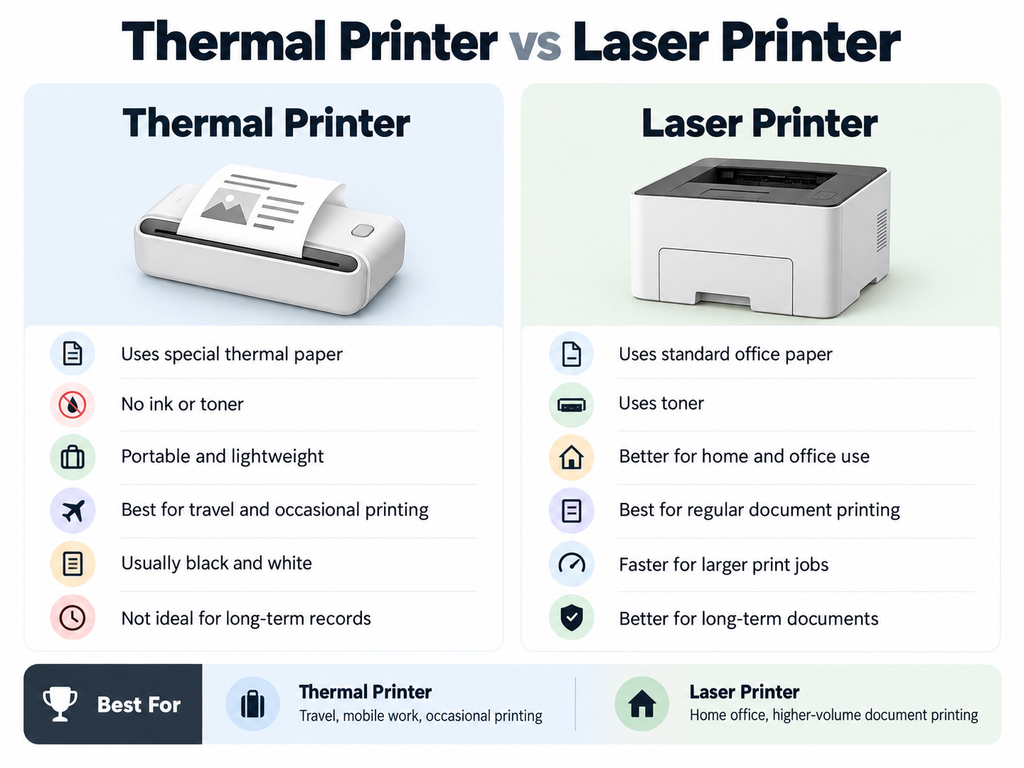
Our short answer: choose thermal if portability and avoiding cartridges matter most. Choose laser if you regularly print A4 documents and want ordinary paper, higher-volume capability and more durable output.
How Does a Thermal Printer Work?
Direct thermal printing is relatively simple.
The printhead contains heating elements that contact specially coated thermal paper. When particular areas of the coating are heated, they darken and create the printed image.
That means a direct thermal printer doesn’t require:
- ink cartridges
- toner cartridges
- traditional printer ribbons
The paper itself is effectively part of the printing system.
This is the technology used by many of the portable A4 printers we’ve covered on WorkTechScout, including models from Phomemo and Kmart’s Anko range.
If you’d like a broader explanation of this technology, see our guide to whether inkless printers are worth it.
How Does a Laser Printer Work?
A laser printer takes a different approach.
Instead of heating specially coated paper directly, it uses toner powder and an imaging system to create the page before heat and pressure fuse the toner onto the paper.
For the user, the important difference is that a laser printer normally works with ordinary office paper.
You therefore need to buy toner periodically, but you don’t need specialised thermal sheets for normal document printing.
Laser printers are common in homes and offices because they can combine:
- fast document printing
- large paper trays
- automatic duplex printing on many models
- high-yield toner options
- Wi-Fi and network printing
- standard A4 paper
Thermal vs Laser Printer: Main Differences
1. Consumables
This is the most obvious difference.
A direct thermal printer doesn’t need toner or ink.
Instead, you continue buying thermal paper.
A laser printer uses ordinary paper but eventually needs replacement toner and, depending on the design and usage, other consumable components.
That means neither technology is truly consumable-free.
Thermal simply moves more of the ongoing cost from cartridges to specialised paper.
2. Paper
Most portable direct thermal A4 printers require compatible heat-sensitive thermal paper.
You normally can’t load a cheap ream of ordinary A4 photocopy paper and expect it to work.
Laser printers are much less restrictive for everyday documents because they normally use standard office paper.
If you’re considering a portable thermal model, check our guide to the best A4 thermal printer paper in Australia before buying.
3. Portability
This is where thermal printers can have a genuine advantage.
Some portable A4 thermal printers weigh well under 1kg and use rechargeable batteries.
For example, portable Phomemo models can fit into a laptop bag and print away from a permanent desk.
A conventional laser printer is substantially larger because it needs a paper tray, toner system, imaging components and power supply capable of supporting the printing process.
If you regularly work from vehicles, temporary offices, university, hotels or other changing locations, a portable thermal printer can be much easier to live with.
4. Printing volume
For repeated A4 document printing, we’d generally favour laser.
Modern monochrome laser printers can hold hundreds of sheets and print many pages per minute without requiring you to manually feed individual sheets.
Portable thermal printers make more sense when you’re printing a few pages as needed rather than working through a large stack of documents.
5. Print resolution
This varies considerably by model.
Many portable thermal document printers use 203dpi or 300dpi printheads.
That’s enough for normal notes, forms and text documents, particularly on 300dpi models.
Conventional laser printers often offer much higher document resolutions. That can produce sharper small text and finer graphics.
If basic text is all you’re printing, however, the practical difference may matter less than the specifications suggest.
6. Document lifespan
This is an important advantage for laser printing.
Direct thermal paper remains chemically sensitive after the document has been printed.
Heat, prolonged light exposure, friction and some chemicals can cause the image to deteriorate.
The National Archives of Australia states that thermal papers are relatively unstable and should not be considered suitable for permanent or long-term records.
For temporary documents this may be completely acceptable.
For certificates, legal records, important financial documents and paperwork that needs to remain readable for many years, we would not rely on a thermal print as the only copy.
Which Is Cheaper: Thermal or Laser Printing?
There isn’t a universal winner.
This is where marketing claims such as “no ink means cheaper printing” can be misleading.
Thermal printer costs
You avoid buying toner or ink cartridges.
However, you need compatible thermal paper every time you print.
For occasional printing, that can be convenient because there isn’t an expensive cartridge sitting unused inside the printer.
But thermal paper generally costs more than basic office copy paper, so high-volume printing can become less attractive.
Laser printer costs
You need toner, but higher-yield cartridges can print thousands of pages before replacement.
You can also use inexpensive standard office paper for most documents.
For someone regularly printing large numbers of text pages, laser can therefore make more financial sense over time.
The important question isn’t simply which printer costs less to buy. Compare:
- purchase price
- thermal paper or standard paper cost
- toner yield
- how many pages you actually print
- how often you print
Which Is Faster?
It depends heavily on the type of thermal printer being compared.
Industrial thermal label printers can be extremely fast for labels and receipts.
But portable A4 thermal printers are a different category.
If you’re printing a batch of full-size office documents, a conventional laser printer will generally be much better suited to the job.
For example, current compact monochrome laser models can exceed 30 A4 pages per minute and hold hundreds of sheets in their paper trays.
A portable thermal printer is designed more around portability and occasional printing than maximum office throughput.
Thermal Printer vs Laser Printer for Home Use
For most households, we’d choose a laser printer if the printer is going to remain permanently at home.
Why?
Because standard paper is inexpensive, documents are better suited to long-term storage and the printer can handle larger jobs more easily.
Thermal becomes more attractive when your situation is different.
For example, you may:
- print very infrequently
- have almost no desk space
- want something that can be stored in a drawer
- need to carry the printer elsewhere
- mainly print temporary black-and-white documents
If your main concern is choosing a printer that can sit unused for weeks or months, see our guide to the best printer for occasional use in Australia, where we compare laser, inkjet and thermal options specifically for infrequent printing.
In those situations, the convenience of a portable thermal printer can outweigh its paper limitations.
Thermal Printer vs Laser Printer for Students
Students are an interesting case because either type can work.
A thermal printer can be useful for:
- lecture notes
- worksheets
- drafts
- study material
- temporary reference documents
It’s especially useful if the student moves between home, university and other locations.
A laser printer is a better fit if they’re frequently printing long assignments, large sets of notes or documents that need to be kept for years.
We’d also favour laser if several people in the household will share the same printer.
Thermal Printer vs Laser Printer for a Home Office
For a permanent home office, laser generally makes more sense.
You get easier paper availability, larger trays and better suitability for regular document printing.
A portable thermal printer becomes more appealing if the “office” isn’t actually permanent.
Someone moving between client sites, vehicles, temporary workspaces or different buildings may value portability more than large paper capacity.
Thermal Printer vs Laser Printer for Travel
This is one of the clearest wins for thermal.
A normal laser printer is not something most people want to carry in a suitcase or laptop bag.
Portable A4 thermal printers can weigh around 700g and run from an internal rechargeable battery.
That can be useful for:
- business travel
- field work
- caravan trips
- mobile service technicians
- sales representatives
- people working from vehicles
For travel, we’d generally choose thermal unless there is a specific need for colour or long-term document durability.
Can a Thermal Printer Replace a Laser Printer?
Sometimes, but we wouldn’t assume it can.
A thermal printer could replace a laser printer if you:
- only print occasionally
- mainly print black-and-white documents
- don’t need permanent records
- value portability
- don’t mind buying thermal paper
It probably shouldn’t replace your laser printer if you:
- print frequently
- print large documents
- want standard copy paper
- need long-term records
- share the printer with several users
- want a large paper tray
For many people, a portable thermal printer actually makes more sense as a secondary printer rather than a complete replacement.
Example: Portable Thermal Printer vs Compact Laser Printer
To make the difference clearer, consider two typical examples.
| Feature | Portable A4 thermal | Compact mono laser |
| Typical weight | Under 1kg on many models | Several kilograms |
| Battery operation | Available on portable models | Normally requires mains power |
| Paper | Compatible thermal paper | Standard office paper |
| Consumable | Thermal paper | Toner + standard paper |
| Paper capacity | Usually manual or small capacity | Often large tray |
| Best use | Mobile and occasional printing | Regular home/office printing |
A good example of the thermal side is the Phomemo M834, which combines 300dpi document printing with a rechargeable battery and portable form factor.
Read our full Phomemo M834 printer review for the detailed specifications and limitations.
Check the Phomemo M834 on Amazon Australia
If you want a simpler thermal option, our Phomemo M08F portable printer review covers the lower-resolution A4/Letter model.
Check the Phomemo M08F on Amazon Australia
Advantages of a Thermal Printer
- No toner or ink required for direct thermal printing
- Very compact portable models are available
- Rechargeable battery operation on some models
- Good for occasional mobile document printing
- No risk of liquid ink drying out
- Simple mechanism
- Useful when desk space is limited
Disadvantages of a Thermal Printer
- Requires specialised thermal paper
- Most portable A4 models print only black and white
- Thermal documents can fade or deteriorate
- Not suitable for permanent archival records
- Usually less practical for large A4 print jobs
- Replacement paper may cost more than basic copy paper
Advantages of a Laser Printer
- Works with ordinary office paper
- Fast printing on many models
- Good for larger document workloads
- Large paper trays are common
- High-yield toner options are available
- Automatic duplex printing is common
- Better suited to documents requiring longer retention
- Colour laser models are available
Disadvantages of a Laser Printer
- Much less portable than small thermal printers
- Toner must eventually be replaced
- Generally larger and heavier
- Requires mains power in normal use
- Can be excessive for someone who prints only a few pages occasionally
Which Should You Buy?
Choose a thermal printer if:
- portability is one of your main priorities
- you print only occasionally
- black-and-white documents are enough
- most documents are temporary
- you don’t want to manage cartridges
Choose a laser printer if:
- the printer will stay at home or in an office
- you regularly print multiple pages
- you want ordinary A4 paper
- document longevity matters
- you want a large paper tray
- several people will use the printer
What If You Still Want an Inkless A4 Printer?
If thermal printing still sounds like the better fit, don’t simply buy the first portable model you see.
We’ve compared the main factors including paper support, battery size, connectivity and portability in our guide to the best inkless A4 printers in Australia.
Australian buyers considering the cheapest entry point can also read our Anko Inkless A4 Printer review.
Our Verdict
There isn’t one winner in the thermal printer vs laser printer comparison because they solve different problems.
For regular home or office document printing, we’d generally choose laser.
Standard paper, higher-volume capability and better suitability for long-term documents make it the more practical main printer for most fixed locations.
For mobile work, travel or very occasional black-and-white printing, a portable direct thermal printer can be much more convenient.
The key is not to choose thermal simply because it doesn’t use ink or toner.
Think about what you actually print, how often you print, where you print and how long those documents need to last.
Bottom line: laser is usually better as a primary home or office document printer; portable thermal is better when mobility and simplicity matter more than paper cost, high-volume printing and long-term document storage.
Frequently Asked Questions
What is the main difference between a thermal printer and a laser printer?
A direct thermal printer creates the image by heating specially coated paper. A laser printer uses toner and an imaging system to produce documents on ordinary paper.
Does a thermal printer need ink?
Direct thermal printers don’t require ink or toner. They require compatible heat-sensitive thermal paper instead.
Does a laser printer need ink?
No liquid ink is required, but laser printers use toner cartridges.
Can I use normal A4 paper in a thermal printer?
Normally not in a direct thermal printer. The paper must contain the heat-sensitive coating required by the printhead.
Which is cheaper, thermal or laser?
It depends on how much you print. Thermal removes cartridge costs but requires specialised paper. Laser requires toner but uses inexpensive ordinary paper and can be economical for higher print volumes.
Which is better for home use?
For most permanent home setups, we’d choose laser. Thermal becomes attractive when you print infrequently, have very limited space or want a printer that can be carried elsewhere.
Which is better for travel?
Portable direct thermal printers are generally far more practical for travel because compact battery-powered models are available.
Which printer lasts longer on paper?
Direct thermal paper is not recommended for permanent or long-term records. If document retention matters, we’d use a conventional printing method and appropriate paper.
Are thermal printers good for students?
They can be useful for temporary notes, worksheets and study materials, particularly when portability matters. A laser printer is better suited to large assignments and documents that need to be retained.
Is thermal printing the same as inkless printing?
Portable printers marketed as “inkless” are commonly direct thermal printers. They avoid ink and toner by printing on specially coated thermal paper.
Sources and Further Reading
- National Archives of Australia – Managing Records on Thermal Papers
- Zebra – Direct Thermal Printing Explained
- Brother Australia – HL-L2460DW Mono Laser Printer
- Phomemo Australia – Portable Thermal Printers
- WorkTechScout – Best Inkless A4 Printers in Australia
- WorkTechScout – Are Inkless Printers Worth It?
- WorkTechScout – Best A4 Thermal Printer Paper in Australia
- WorkTechScout – Phomemo M834 Printer Review Australia
- WorkTechScout – Phomemo M08F Portable Printer Review Australia
- WorkTechScout – Anko Inkless A4 Printer Review
Printer specifications, toner yields, paper compatibility, prices and availability can change. Check the latest manufacturer information before purchasing.